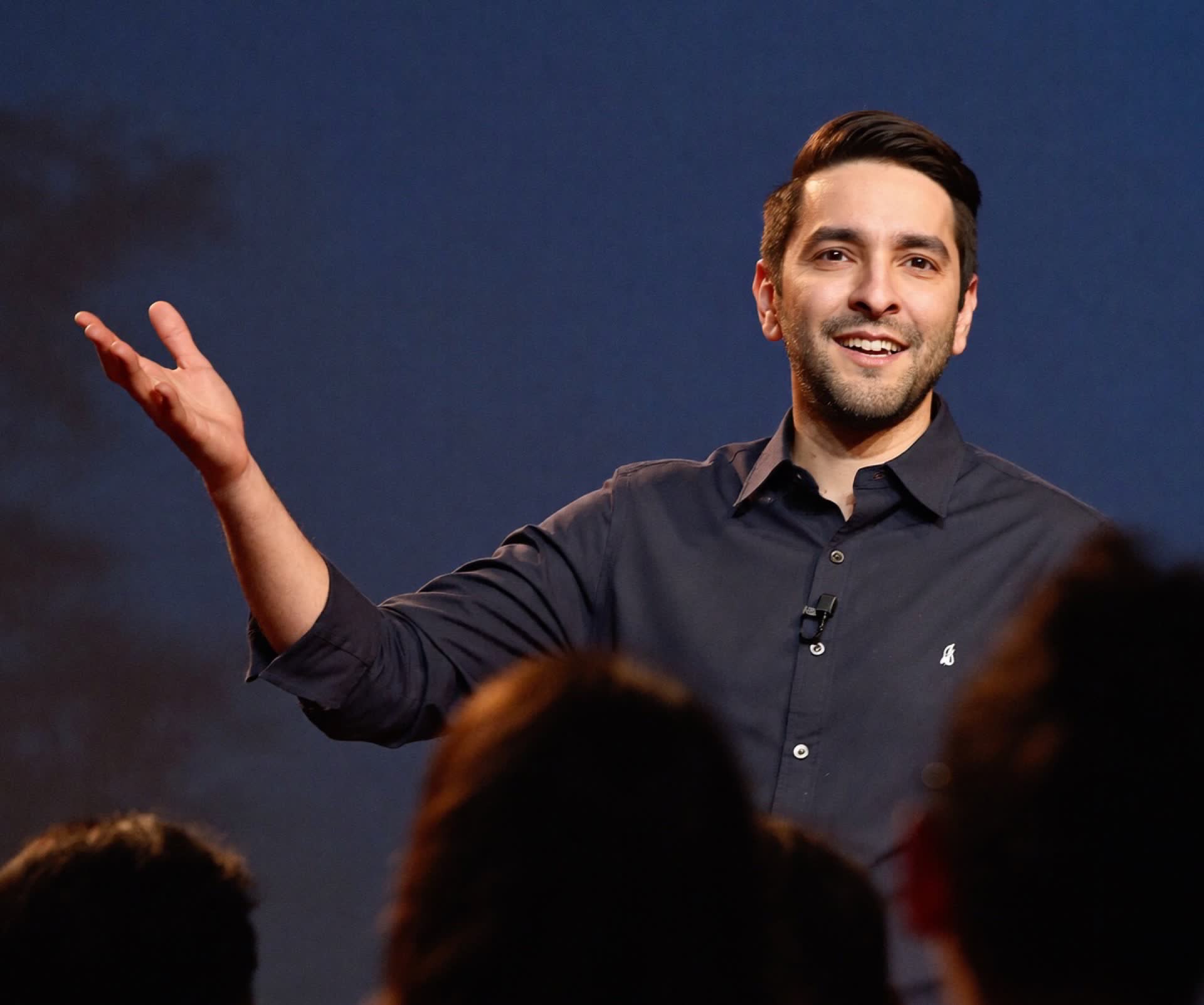
Thought Behind Things · Sep 13, 2024 · 1:20:26
Islamic banking is an oxymoron, says Harris Irfan
Former Deutsche Bank Islamic finance head Harris Irfan tells Muzamil why Islamic banking is a contradiction in terms, why fiat money is the great evil of the modern era, and why he now considers Bitcoin the most ethical form of money ever invented.
with Harris Irfan
12 min read
The book that started as a confession
The episode opens with Muzamil introducing Harris Irfan as one of the leading Islamic finance bankers of his generation — previously global head of Islamic finance at Barclays, co-founder of Deutsche Bank’s Islamic finance team, and now managing partner of Cordoba Capital. Muzamil admits he sent a cold message expecting nothing and got an answer.
Harris’s first book, Heaven’s Bankers, is the entry point. He explains that it documents an inflection point in the industry roughly twenty years ago, when Deutsche Bank moved him from London to Dubai to open its office in the DIFC. Clients there began asking for sharia-compliant transactions, and the team had to learn the discipline from the ground up. They hired Sheikh Hussein Hamid Hassan — the scholar Harris describes as “the grandfather of modern Islamic finance” — and began structuring multi-billion-dollar sukuk to acquire companies, finance airlines, and fund governments.
He is careful not to romanticise that period. “What the bankers did was abusive to the industry,” he says. The book, in his telling, is partly a celebration of what was built and partly a record of how it went wrong. That tension runs through everything else he says in the conversation.
Why Islamic banking is an oxymoron
Muzamil presses the question most listeners are thinking. If sharia-compliant banks in Pakistan are charging the same rates as conventional banks — sometimes higher — and not passing through state-bank rate cuts to depositors, what exactly is Islamic about them?
Harris’s answer is unusually direct for someone with his résumé. “I think the phrase Islamic banking is an oxymoron,” he says. The problem, he insists, is not that the numbers look the same. Profit is permitted in Islam. Trade is permitted. Wealth is permitted, provided it circulates. The problem is structural.
He walks through it carefully. A bank, by legal definition, is an institution that takes deposits and lends money. But the central bank does not require it to lend only what it has taken in. With a hundred in reserves it may lend a thousand, sometimes more, sometimes with no reserve ratio at all. “Where did nine hundred come from?” he asks. “It was invented from thin air.” A visiting Martian, he says, would conclude this was fraud.
That, for Harris, is the disqualifying feature. Islamic banks operate under the same regulatory framework as conventional banks. They have the same legal power to create new money in the act of lending. The halal contracts — wakala, musharakah, mudarabah — sit as an overlay on top of a money-creation business. The contracts may be rubber-stamped, but the underlying act is not permissible. “The very act of creating money in the act of lending, credit creation, that’s money creation. And that’s not allowed in Islam.”
What riba actually means
Muzamil asks Harris to define his terms, and the answer reframes the whole conversation. Riba, in popular usage, is translated as interest. Harris says the word literally means surplus or excess — any excess of money on money. He cites the hadith naming six items as money: gold, silver, wheat, barley, dates, and salt, exchangeable only spot, hand to hand. A hundred pieces of silver for a hundred pieces of silver. Anything more is riba.
The deeper objection is moral, not arithmetic. Riba creates an asymmetric relationship. A lender who is repaid regardless of outcome has no incentive to do careful due diligence on what the borrower is actually building. “Do you think that when a banker is evaluating the acquisition of another company, that he’s really taking risk on that acquisition?” Harris asks. “Or is he saying it doesn’t matter because I’ll get my money back, so I don’t need to do a lot of due diligence on this?”
The Islamic ideal he describes is the opposite: a financier who must act as a partner. Due diligence on the business, the management, the customers, the suppliers, the market. Profit and loss shared on an agreed ratio, fixed in advance. Real-economy transactions underpinned by real assets. “I’m aligned with you. I’m incentivised with you,” he says. It is a different paradigm, not a re-papered version of the same one.
How fiat money built the debt trap
Muzamil tees up the obvious objection. The Western system, however flawed, has delivered modern prosperity. Maybe the old wisdom is just old.
Harris pushes back hard. “Ancient wisdom is always more valuable than contemporary thought,” he says, and then he runs the timeline. Roosevelt’s 1933 expropriation of private gold. Nixon’s 1971 removal of the gold peg. The transition to fiat money — currency by decree, backed by nothing. Once the peg is gone, governments can print, and printing inflates the money supply, and inflation makes everything more expensive. His parents’ generation could run a household on one income. His generation, in the developed world, cannot. The reason, he says, is that everyone is servicing debt, and the debt exists because cheap money inflated the price of every asset that matters.
He frames it as a loop. “More debt, more cheap money, more inflation, another crash. Borrow, spend, consume. Borrow, spend, consume. This is the cycle that we now live in.” He notes that Pakistan has gone to the IMF twenty-four times and has been poorer at the end of each programme. The diagnosis, in his telling, is not the patient.
The connection to perpetual war is a striking aside. Since the gold peg came off in 1971, Harris argues, the United States has remained in a continuous state of war because it can finance war silently — by devaluing the money in every citizen’s pocket. “Fiat money is evil. Fiat money leads to mass slaughter. Fiat money has led to the greatest mechanised murder of people on the planet in history in the last hundred years.”
Why he believes Bitcoin is the most Islamic money ever invented
Harris knows where he will lose half the audience, and he says so plainly. The pivot is a story he tells against himself. In 2017, after a lecture on Islamic finance, someone in the audience asked him about Bitcoin. He admitted he knew nothing about it. The questioner walked him through its properties live, in the Q and A. Scarce. Finite. Divisible. Peer-to-peer. Proof of work required to mint each new unit.
“Wait,” he says he thought. “So you’re telling me it’s like gold. But it’s better than gold because it’s electronic.” He went away and researched it for himself. He returned with a conclusion that still costs him friends: “I now consider it to be the most ethical and Islamic form of money ever invented.”
His defence rests on a re-reading of the hadith of the six commodities. He argues it does not specify the only permissible forms of money — it specifies the rule against riba in their exchange. Anything that society treats as a medium of exchange can function as money. Cigarettes in a prisoner-of-war camp. Seashells on a Pacific island, until a European ship arrives carrying a cargo of beads and inflates the supply. The qualifying properties, he argues, are scarcity, fungibility, durability, and proof of work — and Bitcoin satisfies them better than gold does in the modern world.
Gold, he is careful to say, is still good. He keeps it. But gold requires custodians, intermediaries, and trust. He has worked inside the institutions that custody gold-backed ETFs and he does not trust them. “If I were to go to the vaults of those institutions and say, I have this certificate in my hand which shows I own x amount of gold. Please open the vault and show me my gold. They won’t do it.” Bitcoin, held in self-custody, removes the third party. “Not your keys, not your coins,” he says, conscious that the phrase will mean nothing to most listeners but at least gives them a direction to read.
The volatility objection, answered
Muzamil raises the obvious counter. Bitcoin moves five thousand dollars in a day. That is not money you can pay for groceries with.
Harris concedes the medium-of-exchange point — for now. As a daily currency Bitcoin is not ready. As a store of value, he argues, it already is. He notes that across any three-year window in Bitcoin’s history it has not lost money, and that its volatility today is comparable to large-cap technology stocks. The trajectory, mathematically, is toward a steady state as the network matures. “I never look at Bitcoin on a day-to-day basis,” he says. “I look at my portfolio once a year, and I think on a twenty-year basis when I retire.”
Muzamil offers a reframing that Harris endorses immediately: it is not that Bitcoin is rising, it is that every other currency is falling. “Very well put,” Harris says. “They don’t look at Bitcoin being volatile. They look at everything else being volatile.”
He extends the argument into a recommendation aimed squarely at Pakistanis. Convert a small portion of monthly income. Hold it in self-custody. Do not store it on an exchange. He cites Lebanon and Gaza as places where Bitcoin has become, in his words, a literal lifeline.
The scholar who would not listen
One of the most pointed anecdotes in the conversation is about a senior Pakistani scholar — unnamed, but associated with the Afghan regime when the Taliban returned to power. Harris approached him with a proposal. Roughly seven billion dollars of Afghan reserves had just been frozen in US banks. Why not advise the new government to hold its citizens’ wealth in a form of money that cannot be censored, sanctioned, or frozen by a third party?
The scholar’s response, Harris says, was telling. “Oh, you know, this Bitcoin, it’s all very well. But don’t you think that we should be teaching them about Islamic banking first?” Harris’s reaction was unsentimental. “I said, woah, forget about this. This is a waste of my time.”
Muzamil asks the natural follow-up: why do scholars rubber-stamp Islamic banking products that, on Harris’s own analysis, cannot be compliant? Here Harris is careful to defend them. He names Mufti Taqi Usmani, Dr Dawud Bakar, and Sheikh Hussein Hamid Hassan as men whose intellect and integrity he respects without qualification. Their fatwas, he says, are always context-bound — halal in this place and this time, given the surrounding economic system, not for all time. Their job, he argues, is to uphold the sharia as it stands, not to invent a parallel financial system. “It’s actually financiers, people like me, practitioners, who are there to invent new products and then convince the people and the scholars that this is something wholesome that we should all be using.” He notes that a younger generation of scholars is beginning to work at the coalface alongside practitioners.
Pakistan, the IMF, and a country run by criminals
Muzamil pulls the lens back to geopolitics. The United States, he argues, has been absorbing the world’s productivity for decades and may no longer be able to. The BRICS bloc is rumoured to be exploring a gold-backed currency. Pakistan, meanwhile, is reportedly preparing to sell fifteen percent of the Reko Diq mine — said to hold reserves worth eight hundred billion dollars at current prices — for roughly a billion and a half.
Harris flags that geopolitics is not his specialism, then offers his view as a citizen. “Pakistan is, in my opinion, a country that is run by criminals, and they themselves have a slave mentality. They’re happy to be ruled by foreign interests.” He believes the United States is a ticking time bomb, outplayed by China on electric vehicles, education, and industrial policy. The right preparation for a country like Pakistan, he argues, is to build reserves of sound money — gold or Bitcoin — at the household level if the state will not.
He repeats, with feeling, that custody matters. The government, in his framing, is the biggest single counterparty risk a citizen faces. “Not your keys, not your coins.”
What Cordoba Capital is actually building
Toward the end, Muzamil asks Harris to describe his current project. Cordoba Capital Markets, a subsidiary, issues what Harris calls a profit-participating note — a PPN. It is structured as a return to the pre-banking model of the prophetic mudarabah. He retells the original arrangement: the Prophet, peace be upon him, managed his first wife’s capital, sent a caravan of goods beyond the city walls, traded in the marketplace, returned, and split the profit on a pre-agreed ratio.
That, Harris says, is what Cordoba is recreating in a modern instrument. Real trade. Real due diligence by both manager and investor on what the money will actually do. Profit and loss shared on a fixed ratio. Listed for now to professional investors only — institutions and family offices able to commit at least a hundred thousand dollars — because the digital-asset tokenisation platforms that would let him democratise access do not yet meet his standards of professionalism. He says he hopes that changes soon. He would like, eventually, to take a one-dollar ticket from a freelancer in Pakistan with five thousand dollars sitting idle in a wallet.
Why he is still optimistic about Pakistan
Muzamil closes by asking for a message to a Pakistani audience that is, by his own account, running out of hope. Harris’s answer is the warmest moment in the conversation.
He recounts a recent visit to study Pakistani startup incubators and accelerators, intending to bring lessons back to a project he was setting up in the UK. He says he was “blown away.” The young founders he met had ideas and, more importantly, the ability to execute them in the crucible of the market. “I saw intelligence, hard work, dynamism. Gave me huge optimism for the future.” He believes that if that generation of founders marries fintech to a real-economy, risk-sharing model, Pakistan will be fine.
He says it twice for emphasis. “My head is British, but my heart is Pakistani. My heart is more important than the head.”
Muzamil wraps at the one-hour mark with a request that Harris come back. The conversation, both men acknowledge, has only opened the door.
Full transcript
I looked into Islamic banking and it looks like smoke and mirrors to me. You took everything from conventional banking, you crossed out the word interest and you wrote down the word profit. But the very act of creating money in the act of lending, credit creation, that's money creation. And that's not allowed in Islam. Human beings have suffered greatly because of lending, financiers who lend at interest because of interest. It's a great evil that's been recognized for thousands of years. More debt, more cheap money, more inflation, another crash. Borrow, spend, consume. This is the cycle that we now live in. Financialization is an evil, and I'm telling you that I thought that I could change it from within that environment, but it is just fundamentally rotten. Fiat money has led to the greatest mechanized murder of people on the planet in history.
सामने कावतीर और आज़रात welcome back to another episode of thought behind things. Today we have a very special guest with us before मैं उनको introduce कराऊं. I have to say I will be having this conversation completely in English so I do apologize for that. I know आपने से काफ़ी सारे लोग जो हैं वह बड़े परेशान होते हैं कि यार उर्दू में आप नहीं बात कर रहे हैं. But my guest is joining me all the way from London and he's most comfortable in English as well. This is someone I've been a huge fan of over the last year. Incredible thoughts and I just thought, you know, if he can have him on and he could explain some of those concepts to you, I think, you know, it would be a privilege for me and for you guys as well. I sent him a gold text. I'd never thought he would reply, but he was, you know, gracious enough to accept the invitation. Today we have with us हरिज़ इरफ़ान, who is one of the leading Islamic finance bankers. He was previously the global head of Islamic finance at Group. Before that, he he cofounded Deutsche Bank's world leading Islamic finance team. Currently, he is the managing partner and founder of Cordoba Capital. If if I've pronounced that correctly, Harris, thank you so much for being part of the show. Thank you very much for inviting me, and thank you also for agreeing to conduct the interview in English. I'm afraid my उर्दू is very very rusty and I would just silence my shelf.
That's perfectly alright. You are originally from Pakistan or? Yeah, we were merited as पाकिस्तानी. My father came to The UK in 1960.
Oh, wow. One of the, probably one of the earliest ones. Earliest pioneers, yeah. So I'm gonna start this conversation. I noticed today actually I just found out you actually wrote a book Heaven's Banker inside the hidden world of Islamic finance. Run me through what was that book about and how was that experience? Sure. It's really
it's a history of what happened about twenty years ago because that was an inflection point for Islamic finance, the industry globally. And the reason was because I had been transferred by my then employer, who was Deutsche Bank, from London to Dubai. And I was the first Deutsche banker on the ground. And, they asked me to open the office and originate new transactions for the bank from there. And when I arrived, a lot of, prospective clients of ours said, we would like you to do these deals on a sharia compliant basis. And we didn't know what that was. And so we learned at the feet of the scholars. In fact, we hired probably what was the world's most important scholar, most well known, a guy called Sheikh Hussein Hamid Hassan, who is essentially the architect of the products that we put together. And he's known as the grand father of of modern Islamic finance. So, you know, a very key player in the industry for many, many years. And, and, actually, what we did at Deutsche at that time was just revolutionary. The Islamic finance market had been sort of a sleepy backwater for many years producing, you know, a few products here and there. But all of a sudden, this what they called flow monster, Deutsche Bank was one of the world's leading investment banks, turned up and just turned it on its head. So I co founded the Islamic finance team at Deutsche, and we started doing things that had never been done before. So you may have heard of things like sukuk, which means an Islamic bond, which is a type of financing instrument. And we started to do these on a very large multibillion dollar basis to acquire companies and finance airlines and finance governments and so on. And so we really developed and invented a new market. So I decided to document the the living history as a primary source in this book, Heaven's Bankers, to show what was possible in the industry and what went wrong because things did go wrong. And I'm afraid that what the bankers did was abusive to the industry. And we can talk about that in some detail as we go on, but, essentially, it's a it's a it's a documentation of that process. Interesting.
And this was basically the boom that was happening in The Middle East as well. Dubai was really, coming up, and a lot of other capitals in the region were also really beginning to develop themselves. Were were you dealing with just Dubai or were you all across the MENA and beyond region?
So our remit was global and we were producing financial product that we could be bought by customers in The US, The UK, anywhere in the world. And, but Dubai was the epicenter of that revolution. And that's because we were able to attract a lot of expats with strong technical skills. Some of them were, you know, credit traders. Some of them were equity derivative structuring. Some of them were so very many different disciplines within an investment bank suddenly converged in Dubai with these very technical skill sets, and they applied their ability to solve complex puzzles to a शरीर compliant setting. So it's really puzzle solving. And, originally,
I mean, you mentioned early, you said, you know, a lot of this big became very abusive in the later years. Do you think the core foundation of the शरीर compliance or the Islamic banking was flawed to begin with? Or do you think it started with the right, in the right direction, but really eventually lost its way?
But I tell you what. I I think that when people like me started arriving in Dubai, in the DIFC, the Dubai International Financial Center, we had this vision of what we wanted to try and achieve. And that vision was a good vision. I mean, we were ideologically driven. We were actually young, practicing Muslims. We believed in the concept of an Islamic economic model. We felt that an Islamic finance industry was a good thing because it was ethical finance. And we actually, we wanted to do the right thing, and we thought we could do that from within a conventional banking environment. Because, of course, banks are the dominant player in global finance. So if you work with a really heavy hitter like Deutsche Bank and you invent a new division within that, is called Islamic finance, and you invent new products, and you've got the right people who are technically capable, they're kind of motivated, dynamic, hardworking, young, and they're ideologically driven, we felt that we could make a difference. And we initially started that way. I mean, we really were trying to create financial product that aligned with the ethical principles of Quran and sunnah. But in time, I have come to realize that it's pretty much impossible to change the economic model from within an inherently flawed system. You cannot create Islamic finance on top of conventional finance. You have to separate, and you have to do it in parallel. It's a system that needs to develop away from conventional finance for reasons that I can I can explain? Makes sense. If if, you know, I come back a little bit,
and I let's talk about Islamic finance then, because you said, you know, this you can't really evolve out of the current system. You actually have to create something alternatively. For for Pakistan, for example, and across the region, we're now beginning to hear all about Islamic banks, Sharia compliant banks, and people get really, really confused because it, to me, very honestly, and this was not like this few years ago, but most recently, it seems like you're you're really selling the same thing just to rebranded it in a different way. If the if the bottom line is the same, then it doesn't really matter what the paper says. You know, oh, this is backed by some, you know, some asset or, you know, you're gonna do this and based on that, you're going to rent it. And the numbers are the same. More often than not actually in Pakistan, a lot of the शरीर compliant banks have been, you know, have have not been passing down the the interest, you know, that the, let's say, the state bank has. So now the profit profitability has actually increased. So even the the depositors are at the losing end, the bankers are basically making great bucks. And so to me, doesn't seem like it's there's any difference. But I want to really sort of roll back and ask you, how do you define conventional banking slash conventional economic system as you'd put it and Islamic banking, Islamic finance, or Islamic economic model because you did mention ethical considerations. But what other things are there?
Ok. So, मुझे one of the other reasons I wrote the book was because, and this is going back sort of ten, twelve years now, It was because a lot of family and friends essentially said the same thing as you, which is, hey. I looked into Islamic banking, and it looks like smoke and mirrors to me. It's like you took everything from conventional banking. You crossed out the word interest, and you wrote down the word profit. And you charge me the same. Actually, sometimes you charge me more. So what's so ethical about that? And I agree. I I think that there's a problem there. But not because the numbers are the same. That's not the reason why I have the problem. Because, actually, one is allowed to make a profit in Islam. You're allowed to be to a to be a trader. You're allowed to earn profit in a halal and ethical way. You're allowed to spend your money anywhere you see fit as long as it's halal. Right? There's no sin in being profitable and rich and wealthy, but there's goodness in distributing that wealth and spreading money throughout the economy called money velocity. This is a good thing for society. Everybody levels up together. But the problem that I have is not that the numbers are the same, that the profitability can be the same. It's that the fundamental basis on which Islamic banks operate is problematic. And I explain why. I think the phrase Islamic banking is an oxymoron, meaning that they're mutually incompatible. A bank, by definition, is an entity that takes in deposits and lends out money. Now people think that it it lends out what it takes in as deposits. That's not true. Actually, a central bank regulates the banks so that they may take in deposits, but only as reserves. They are allowed to lend a much higher number than they take in as reserves. So if they have a 100 in reserves, they can lend a thousand. In fact, it can be an even higher number than that. Some countries don't have any reserve ratio. So you have this situation where a bank is an institution that has the legal right to create money from nothing. Imagine this. You took a 100 in deposit, you lent a thousand. Where did 900 come from? It was invented from thin air. And people find this a very strange thing. You know, if a Martian landed on this planet and and examined what banks do, the Martian would reasonably conclude this is a form of fraud. How are you perpetuating a fraud on people? Where did you create new money from? The reality is banks are in the process, are are in the business of creating money from nothing. So this is inherently a morally fraudulent transaction and inherently not Islamic, not Sharia compliant. You can't create money from nothing. Money is something that is used as a medium of exchange and cannot be invented from nothing. It requires something to qualify as money, and we'll we'll go into what that is. So here we have a situation where Islamic banks are essentially regulated in the same way as conventional banks. In other words, they have the power to create new money in the act of lending. And yet, you're not allowed to do that in Islam. So what they do is they put halal contracts as an overlay on top of this banking business model. And they say, because our contracts are, and they use Arabic words like, etcetera. And you think, oh, okay. It's halal. A scholar said this is halal because it's wakala, because it's musharaka, because it's mudara. Fine. They rubber stamp it, and they say it's fine. But the very act of creating money in the act of lending, credit creation, that's money creation. And that's not allowed in Islam. So it's, you know, it's a paradox, and it's an oxymoron, Islamic banking. I think Islamic finance should be based on a purer Islamic economic model. So, Allah says in the Quran that he has made trade halal for us and ribah haram for us. And people say, what is ribah? Well, very simplistically, riba is interest. But, actually, riba has a much wider definition, that is is quite technical, in fact. And and I'm not gonna go into the great detail of that, and Abu Fti can explain that better than I can. But riba is essentially the word means surplus or excess. Any excess of money on money is. Now there are there's a famous hadith in which, six items are named as things that can be used as money. They're not necessarily all the things that can be used as money, but they are named as gold, silver, wheat, barley, dates, and salt. And it is the hadith says that you may any only exchange these at spot, hand to hand. In other words, I can't give you a 100 pieces of silver and say I want a 110 pieces of silver back because then I've preated 10, which are ribber. And the same applies to dates, wheats, barley, but by extension to anything that could become one or could become a medium of exchange or could become inventory even. So, riba is really an excess, and it it it essentially is something that is unethical because it creates an asymmetric relationship between a borrower and a lender. Islamic economics is about creating symmetric relationships between parties so that we share risk. As you know, if you borrow money from a bank and you fail to make your payments and you default on your payments, then the bank can take extra security. It can repossess your the asset that it was financing or your house or your business or whatever it is. Are they really taking risk? Do you think that when a banker is evaluating the acquisition of another company, that he's really taking risk on that acquisition? Or is he saying it doesn't matter because I'll get my money back, so I don't need to do a lot of due diligence on this? What if you had an economic model in which a financier, and I'm not going to use the word banker now, in which a financier was incentivized and effectively forced to do extra careful due diligence on whatever it was that he or she was financing. And they were they had to go into the nth level of detail to ensure that this is a good quality investment that they are making. Notice that I said the word investment. They're no longer lending money. They're making an investment as a partner in something. So and now let's use the ideal model of an Islamic financier following the Islamic economic model. That individual is somebody who must act as a partner in an investment. So they say, okay. You have a business. I'm gonna conduct due diligence on your business. I'm gonna make sure that's a high quality business. I'm gonna evaluate the management. I'm gonna evaluate your customers, your suppliers, your market. I'm gonna do scenario analysis. I'm gonna make sure the business model is a really good one before I decide to invest my and my customers' money. And then we are going to share the profits or losses on an equitable basis so we can decide upfront what that ratio is. It could be fifty fifty. It could be ninety ten. It could be whatever we determine between us As long as we know upfront, there's no uncertainty. So now I've entered into, number one, a real economy transaction, which means that it's underpinned by a real trade or a real asset, and I've evaluated your business carefully. I haven't just said, you know what? I'll look at your financial statements. Are you a good credit or a bad credit? Here's some money. Give me some money back with interest. I don't really care what happens in between. No. Instead, as a financier, an Islamic financier, I should be saying, I've done extra careful due diligence on you. I like what you do. I decide to invest in you, and I want a careful monitoring of all the trade activity that you do with the money that I give you. And then I want to split the profits at the end. So, a, it's real economy, and, b, it's risk sharing. It's profit sharing. I'm not saying give me 10% back. Come hell or high water. I don't care if you do well or you do badly. I want my money back, and I'm gonna repossess your house if you don't. No. The financier is saying I will share in your profits or losses. I'm aligned with you. I'm incentivized with you. That means I have to make sure that you are performing well, and I will give you help to perform well. This is a very, very different paradigm, a different model.
We do not metric relationship. I understand. But if I were to sort of, actually, let's take it step by step. Question number one. For a lot of people, when they're looking at, you know, stuff like interest or they go around and they think, okay. So Islamic finance is something that is inherently a spiritual thing. And, you know, I'll make god happy if I don't get the house on mortgage. And so I just, you know, build cash and then go and buy something. But, unfortunately, you're now living in a system where, especially in the Western world, it's increasingly impossible to buy your car on cash, buy your house on cash because the system is such that everybody's, nobody really has, can afford a house. And so they drive the prices of the house up because everybody is loaning it. Right? So you're the one who's on the losing end if you're waiting to sort of save the cash for it. But so a lot of people are either say, you know, I it's a system. I can't be out of the system. So what do I do? And the second thing that they think is, you know, the system is working, and it's giving you great development, and it's great. It's it's, you know, look at the West. They're doing so great. So so clearly, this is a better system. Islam Islamic finance was primitive. It was old. It was for a different time. But then based on what you just said, makes me feel like, you know, if there was islamic finance involved, the o eight crisis would never have happened where even you disconnect the real economy from the sort of, you know, numbers economy and you keep on building products on top of that and start selling it, you know, it's at some point, it does crash. And so I want to understand, is Islamic finance just this, you know, idea that is great for you spiritually for the hereafter or does it have roots within the structures of the global finance, that, you know, if you look at look at it in a long enough time line? Yeah. I'm smiling as you say this because
it's there's so much to unpack in what you just said, and, we need a week to discuss it. So I'm gonna try and compress it into five minutes. Where shall I start? The first thing I will say is ancient wisdom is always more valuable than contemporary thought. So let's now talk about specifics. Keynesianism is a form of economics that has been dominant for the past hundred years or so. And, sometimes we refer to neoliberal economics. Sometimes we refer we refer to other, schools of thought. We call things like Chicago School of Economics. We talk about financialization, which is the proliferation of debt and financial services in society, which became more prevalent post, I guess, the nineteen fifties, but especially post the nineteen eighties after Reaganomics and Margaret Thatcher and so on. So we live in an era of cheap money, and let's let's take another step back. Let's talk about ancient wisdom. I know I think it's not unfair to to ask the question, so what if people two thousand years ago said this was a good form of economics? We live in a modern society. We do you know, we have mobile phones and silicon chips, and, you know, we process transactions from one side of the world to the other in a matter of milliseconds. You know, what use is a form of economics that was invented fourteen hundred years ago or maybe even five thousand years ago? Well, again, I come back to this idea of ancient wisdom being very valuable. And sometimes we forget that in a modern society where everything happens very fast and trends happen very fast. From one day to the next, we don't know what gender we are anymore. So, you know, this is a relatively recent phenomenon. And I think that if we go back to the roots of what ancient wisdom says about money and economics, we'll find some things in scripture, not just Islamic scripture, but also Christianity, and also other religions, Abrahamic finance, you might even call it, in which we we see that over a long period of time, human beings have suffered gratefully because of lending, because of financiers who lend at interest, because of interest. It's a great evil that's been recognized for thousands of years, and it's really in the last hundred years that it's accelerated beyond all recognition. So we now have a situation where, as you said, young people can't afford to buy a house. In my parents' day, one person in the household was the breadwinner. The father, earned the mother brought up the children, and households were able to afford their monthly bill. And and I'm talking obviously about the developed world because there are different models there compared to the rest of the world. But, you know, certainly in the developed world, they were one income households. And then over time, over the last fifty years, they've become dual income and even more people in the household earning money just to keep afloat. Why is that? Because they're all servicing debt. Why are they servicing debt? Because we have cheap money. How do we have cheap money? Well, in 1933, president Roosevelt, expropriated gold of US citizens. And, and, essentially, this was a form of theft. So gold was taken away from private citizens and into public ownership. And then in 1971, the there was the final nail in the coffin of sound money, which is when Nixon removed the gold peg that underpinned the US dollar. So then the US dollar became essentially meaningless. The dollar became a fiat currency. Fiat means by decree. Something is decreed to be currency by a government. So all money that we use in the modern world, whether it's euro, yen, rupee, dirham, pound, dollar, these are all fiat currencies. Governments say this is the currency. What does it mean when you remove a gold peg from a currency? It's no longer backed by anything that has value. And now the dollar can be whatever the government deems it to be. So if the government keeps on printing new money, and sometimes they give it fancy names like quantitative easing, but, essentially, it's printing money. As long as they keep printing money, they are inflating the money supply. When you inflate the money supply, you flood the market with new dollars. What does that mean? Each dollar is worth a little less. Every new dollar that comes in circulation, you've reduced the value of dollars. You've diluted the value of dollars. What does that mean? Inflation. It means goods and services become more expensive. They become so vastly more expensive, but now you need two people in the household to support a family's expenses, not one. Now yellow people can't afford to get on the housing ladder because houses have become so expensive, inflated by cheap debt that makes them more and more expensive because rich people can borrow more debt. This is the irony. Right? If you're poor, you can't afford to borrow debt. It'll cost you too much. If you're rich, you can borrow as much as you want. Right? And the housing stock is inflated in value because of inflation. It's a double whammy. So now you have the stock of housing is just too expensive for young people to get on the ladder, and it's a never ending crisis. Eventually, there'll be another crash. This is what happens with fiat money and financialization. More debt, more cheap money, more inflation, another crash. Go back to the beginning. More debt, more cheap money, more inflation, crash. Borrow, spend, consume. Borrow, spend, consume. This is the cycle that we now live in for the past, well, since the nineteen eighties at least. Financialization is is an evil. Right? I say this as a former investment banker. I come from that background. I'm an insider. I know exactly how it works. And I'm telling you that I thought that I could change it from within that environment, but it is just fundamentally rotten to the core. So you have this situation where, you know, some people will say, okay, but a little bit of interest is good because we need credit. We need to be able to finance things. Right? I think that let's let's, for a second, leave aside the fact that we live in an economy where debt is necessary because, you know, we goods and services have so inflated beyond our means that we have to borrow. Why do we borrow in the first place? Why do we not have an economic system in which it is very difficult to inflate prices of goods and services? Pakistan's a very good example of that. Pakistan has been to the IMF, I don't know how many, 20 times or so? Right. 24 times. And each time it gets poorer, and each time the IMF says, well, if you do this and you do this and you do this and you introduce austerity and more taxes and you create more burden on people and you make people more oppressed and poorer, then, you know, we'll give you some money to bail you out. And each time they get poorer, you know, you would have thought that we would have learned by now. Right? 24 times later, we get poorer each time the IMF says they're gonna bail us out. Right? I think there is a solution, but it's a solution that's so radical that at this point I lose people. Right? So I I was a believer in the gold standard. I was a believer in a form of money that is commodity backed, that is solid, that is chemically durable across time and space, that has been used for five thousand years as a medium of exchange and a store of value. So it has historical precedent. And it's scarce. It's finite. You can't magically produce more of it even though alchemists have tried in history. They haven't succeeded. You have to mine it from the ground. It requires energy and work. Proof of work is required to extract it from the ground. These are all characteristics of what is known as sound money. And for many years, it did act as a sound money until it was stolen by the US government, until it was centralized by the US government, until it has become manipulated by large institutions. And it's also impractical because one cannot do a multibillion dollar transaction and send money halfway across the world in an instant, in a fraction of a second with gold because it's big and heavy, and it requires transportation and so on. I can't go to local groceries and pay for my groceries in gold coins because it'll give a fraction of a coin, and I can't cut up gold coins. So it's impractical. Is there an alternative that is also scarce, finite, divisible, electronically transferable, fungible? Meaning that one unit of that currency is the same as another unit of a currency. Diamonds, for example, can't be used as currency. Why not? Because one diamond is not the same as another diamond. Right? They're they're not fungible. Whereas a dollar is fungible. $1 is the same as another dollar. Gold is fungible. One piece of gold that weighs the same and has the same purity is the same as another of the same weight and purity. These are fungible types of currency. So scarce, finite, what's the other major thing that we need for sound money? Proof of work. The dollar does not have proof of work. What do I mean by that? It takes no energy for the US government to print dollars. That's why they flooded the market trillions of dollars in the last few years. There's been a massive inflation of the money supply. In Pakistan, we may think that the dollar is a very sound currency because our rupee has been devaluing over so long that we say, well, the rupee is a terrible currency. The dollar's a hard currency. It would be great if we could use the dollar. Obviously, you can't impact some. But we have this idea that the dollar is a sound currency. But, actually, the truth is the opposite. If you held a $100, in the year 1900, by the year 2000, those $100 are worth only $4 in real terms after inflation. Your dollar has devalued 96% in a hundred years. It's a massive devaluation that is now accelerating because of the inflation of the money supply in order to address crises like depressions and recessions and COVID and this and that, and and financing wars, by the way. You will notice that since 1971, when Nixon, removed the gold peg to finance the Vietnam War, The US has been in a perpetual state of war ever since then because it can finance it by stealing the wealth of citizens through, inflation, by devaluing money, by increasing the money supply. It's an excellent way to finance war, and that's why they've been in this perpetual state of war. So fiat money is evil. Fiat money leads to mass slaughter. Fiat money has led to the greatest mechanized murder of people on the planet in history in the last hundred years and the greatest, environmental pollution in history in the last hundred years. What if we had a form of money that had all the characteristics of sound money, scarce, finite proof of work. You need to extract it from something. It requires energy to do so because that's what makes it a good form of money. And I came up with the answer. I was delivering a lecture in 2017, and I was doing my usual lecture on Islamic finance. And somebody in the audience asked me, what do you think about Bitcoin? So here's where I'm gonna lose some of your audience. Because there's a there's a stronger there are many stronger pins about Bitcoin, especially from scholars, by the way, which I'm happy to get into. And I said, I'm sorry. I I really don't know much about Bitcoin. Can you explain it to me? And he said, okay. It has this characteristic, that characteristic. And he explained it to me, and this is kinda real time in the q a q and a session in the audience. And I said, wait. Wow. So you're telling me it's like gold. So here, it's like gold, but it's better than gold because it's electronic. It's transferable in milliseconds from one person to another. It's peer to peer. That means it doesn't require an intermediary like a bank. That means you and I can trade something using Bitcoin immediately without requiring 19 intermediaries. By the way, whenever you make a transaction on your card, your ATM card or your credit card, there are 19 intermediaries that need to be paid in that process. It's a highly inefficient process, modern banking. Bankers always get their cut. There's always somebody there's 19 people in that chain who need to get their cut. Bitcoin is peer to peer. Me and you, we can trade something. That's the beauty of it. So he explained all these characteristics to me, and I said, okay. You know, I didn't know anything about Bitcoin, but I'm gonna have to go and research this. And I did, and I came to the conclusion that the characteristics of Bitcoin are better than gold, which is why I now consider it to be the most ethical and islamic form of money ever invented and at that point people lose their minds okay half of them say yeah I'm I'm I'm on I'm on board with this I love this this is fantastic I didn't know this and then half the people say This man has lost his mind. You know, he's got he's monazic or something. He's gonna get a hell of has a Bitcoin course, and he's trying to double that. Right. Exactly.
So so it's it's a tough conversation to have with people because it's very controversial. Let's break this down a little bit before we move to Bitcoin. I wanna understand before so we've established that feat based on the fundamentals of Islam would be inherently un Islamic because someone somewhere is just basically multiplying and creating money out of thin air and so that just it it goes against the core tenet of Islam. Was it the same pre 1971 when when, you know, currency was pegged to gold? Or rather if I were to flip it, let's assume in October in the Kazaan summit, BRICS comes out with, let's say, you know, a BRICS currency, and it's backed by bricks of gold. And, you know, suddenly they provide an alternative and talk about it create an entire narrative of how, you know, The US quack economy has really sort of the imperial US empire has taken over the world through their financial system. And so now we are coming up with a currency that is more rooted in fundamentals. And we saw, you know, India and Saudi and China has been hoarding gold over the last many quarters while simultaneously dumping US treasuries. Yeah. If we see such an alternative currency emerge, would you consider that to be more Islamic or would you consider that to be the same of, you know, what we already have?
So, a lot of Muslims will argue that gold and silver bimetallic currency are the only valid Islamic forms of money. And then they refer to that hadith that I mentioned in which six items are mentioned, gold, silver, dates, barbi, wheat, salt. And they will say, bitcoin is not backed by anything real. It's not a commodity asset backed. And my argument is that hadith does not mean what they think it means. That hadith specifically refers to exchanging something that may be considered money, spot, hand to hand. In other words, no ribber, no excesses allowed. It's not specifying that only those six types of commodities may be money. In fact, anything may be money. Anything that society deems to be a medium of exchange or a store of value can be money. For example, if you are in a World War II prisoner of war camp, money would be cigarettes. That's how you would trade with each other. That's what was available. If you lived on an island in the Pacific Ocean a hundred years ago, your money might be seashells or beads. Right? It's not a very good form of money because as soon as a European ship arrives carrying a cargo of a 100 tons of beads, suddenly your money supply is inflated, and it's worthless. Right? So it's not a great form of money, but it may be used as money on that island until those Europeans arrive. So, you know, whatever society deems by social custom to be money may be money. However, I think gold is a particularly good form of money. I think historically it has precedent. It's difficult to extract from the ground. It has a high what's called stock to flow ratio. In other words, there's a lot of stock of it in the ground, but there's only a small flow of it coming out of the ground at 1% per annum. So that makes it a good form of money. It means it doesn't, devalue over time. In fact, you if you did some research on that, you'd be able to work out based on hadith from fourteen hundred years ago, the value of livestock, say, a a sheep or a goat in grams of gold is roughly equivalent to the value of livestock today in the same grams of gold, meaning gold is a stable currency. But there's a problem. So when the BRICS countries get together and they say let's say they said, okay. We're now gonna create a new currency monetary block, and we're gonna use, gold as the backing of this currency. In theory, I think that sounds great. In practice, gold is, very impractical. We can't carry it around. Maybe you could argue, well, we've all got mobile phones these days, so we could have a certificate that that shows how much gold we actually own in a depository somewhere. But now you've introduced counterparty risk, intermediary risk, third party risk. Now you have to trust intermediaries to handle things correctly. For example, if I go and buy on a stock exchange somewhere today, a gold fund, what they call an ETF, exchange traded fund. It's like buying a a share on a stock exchange, And it's backed by gold. At least they tell me it's backed by gold. If I were to go to the vaults of those institutions and say, I have this certificate in my hand which shows I own x amount of gold. Please open the vault and show me my gold. They won't do it because many of those ETFs are not actually back to one for one. In many cases, they've sold that certificate many times over. And I don't trust those institutions. I know because I've worked in those institutions. I know exactly how they work. They will do whatever they can to try and get away with to make as much money as possible. Profit maximization is their religion. So if I have to introduce a third party to custody my goal, I'm already at a disadvantage. That's one of the reasons why, although in theory, I do like the idea of gold and it has historic precedent and it's a sound form of money, in practice, would require trusted intermediaries. I would require central banks to do what they do, and I don't trust central banks and governments to do the right thing. I it couldn't be a peer to peer transaction. We couldn't exchange gold between ourselves because we'd have to go through intermediaries. So there are many flaws there. It's better than fiat currency. I'll give you that. But there are still flaws, and that's why I'd even appear to pay currency. So can we then potentially say that the currency itself
would inherently be Islamic, but because it would fuel the same sort of financial system that we currently have with a lot of these instruments and, you know, just a layer over layer of, you know, some sort of an MLM or a Ponzi scheme on top. So, inherently, it would lead to the same outcome that creates that sort of boom, bust, crash, over consumption, all of the things that inherently are plaguing our societies today. And so my next question to you would be, again, before we go to the Bitcoin part, because I feel like that's that's the that's the future. Right? But I wanna understand the present right now. Do you do you do you think the current debt based system is sustainable? Like, is there any way? Because the way that I see it, you can you can accelerate or decelerate the crash, but a crash will always come. Like, there's just absolutely no way because it is not optimized. It is not you know, I was just looking at this very interesting chart where in 1971 when the gold peg was taken off, the productivity kept on rising, whereas the compensation sort of, you know, plateaued. And so in such systems, when you you're able to, again, do quack economics where you can fool the public or fuel fool a segment of the public, inequality is inherently going to grow. And every time in history when inequality has grown to a certain point, society goes through major upheavals. And so it's not a matter of if, it's a matter of when a bunch of people have a bunch of different theories. Some would say next year, some would say fifty years from now. But eventually, humanity will, that's my opinion, but humanity will eventually have to pay for the excesses that we're taking right now because the debt based system. What are your thoughts on that?
So as you were saying that, I started thinking of something called the law of jubilee. It's actually recorded in the Bible. And in the fifth century BC, the governor of Judea, Nehemiah, I think, instituted a law called the law of jubilee. And every sabbath year, every seventh year, he would make sure that all debt slaves, debt peons, would be returned to their families. So, of course, you have these societies where debt has proliferated, the financiers have lent money, and collateral is demanded by those, financiers. They say, what collateral? You know, if you can't offer your assets, then you offer your family or yourself as a slave in case you can't pay your debt. And, of course, if there's too much debt in society and too many debt slaves, what happens? They overcome the number of free people in society, they overthrow them. So a ruler has to be very wise to this and say, okay. I'm gonna make sure I don't get overthrown by the slaves. I don't want a revolution happening. So every seven years, I will I will have a law that says the debt slate, the debt peons are returned to their families. And I was thinking of this as you were saying this because, you know, as we create a society in which debt is incentivized and which cheap money is incentivized, you create a society of economic dependency. And here in The UK, for example, anyone who wants to go to university has to take out a massive loan, a massive loan that they will pay over maybe decades of their lifetime to go to university. It's a scam. They've when I went to university in the early nineties, only 10 to maybe 15% of young people went to university. So university was was, at the time, seen as a sort of academic peak. And then Tony Blair came along, and he said, I wanna make sure that 50% of young people go to university, which in theory sounds great. Right? But in practice, what it meant was you have a proliferation of poor quality institutions offering useless, worthless degrees in subjects that are no use to anybody. Right? And people are paying 10,009 thousand pounds per year as a local student to go to these universities for three or four years. Plus accommodation, plus maintenance costs, plus buying books, plus living expenses. They're easily racking up $5,060,000 pounds as a student. It's a huge number. They'll pay that off over their lifetime. For what? What benefit did it actually give them? This is an example of creating economic dependency. It's perfect for financial institutions. It's perfect to create a society in which we all become debt slaves. We're all paying half of our monthly net income after tax into repaying some debt, whether it's our house or our car or our mobile phone contract or our student loan. What kind of society is that? So, I mean, I think that we're in a situation where we've created this borrow, spend, consume model. And I think that there's a solution to get away from that. I think the reason why we've created boom bust cycles is because we've inflated the money supply. So some people will argue, well, the fact that you can issue new money is a good thing because it means you can cope with crises like COVID, like a depression or recession. And I would argue, why did that depression or recession happen in the first place? Right? It happened in the first place because you created inequality, and the financial system collapsed. I'm of the opinion that, you know, the global economy is a bit like a heroin addict, and we keep feeding him methadone, and somehow he's still alive. But it's getting worse and worse. And I I had this awful feeling of dread that it's gonna collapse, and it's gonna be even bigger than 2007, 2008. So, personally, I'm a risk averse person, by the way. You know, people say, oh, Bitcoiners, they're speculative gamblers. No. No. I'm the exact opposite. I'm a risk averse person. Right? I fear the worst, and I prepare for the worst. And for me, asset classes like gold and Bitcoin are hedges against financial Armageddon. They're there to protect me from the worst case scenario. So if the global economy crashes, which I happen to think it has a reasonable chance of doing so based on the fundamental factors that I see, then what's gonna survive in that? Initially, everything will go down. Everything. Stocks, bonds, real estate, gold, silver, copper, all commodities, they'll all collapse in value. Bitcoin will collapse in value. That's a surety initially. But then certain asset classes will begin to come back when people realize that these are stores of value, long term value. Gold always has been a long term store of value. So that's a natural thing to hold in the event of a collapse. But I happen to think that Bitcoin has even better characteristics than gold. That's why I believe it's a risk averse hedge against financial आवाज़ग़ैद.
Interesting. A lot of people so talking about Bitcoin, a lot of people have a problem with the with the, you know, extreme volatility. So if you look at Bitcoin as a currency, it's it's very problematic. You know? I mean, I I I buy Bitcoin today, and to tomorrow, let's say, it just loses $5,000 in value, and suddenly I've lost a lot of my net worth or my productivity that I have stored in that sort of store of value.
How do you reconcile with that aspect of it? That's a very good point. And, that's one of the arguments that scholars will use, theologians will use and say, the ones who say bitcoin is harm, they often use the argument that it's volatile, therefore it's gambling or it's uncertain. Uncertainty and speculation. What I would say to that is, first of all, if you're investing in a startup company, that's also speculation of a sort. Right? How does any company start? When you invest initially in a startup company, you may lose all your money. That's that's the most form of volatility you can have - minus a 100%. Right? You can also make a lot of money. We're at a relatively early stage of Bitcoin's evolution. Right? We're just over a decade into this experiment. And, it's an experiment. I don't know if it's going to be successful. But I'd prefer to believe in a world with Bitcoin than without Bitcoin. If we just use the philosophical tools of argument and do a thought experiment and say, what does a world look like which has Bitcoin as a type of money and which doesn't have Bitcoin as a type of money? What do those two worlds look like? And when you examine it dispassionately and you argue for and against, you start to realize, I would rather prefer a world which has a sound form of money. Now let's talk about volatility. Over time, the volatility of Bitcoin has decreased massively where we're tending towards a steady state equilibrium. So, for example, the volatility of Bitcoin today is no more than big tech stocks. If you were investing in the Nasdaq. Yeah. Google, Microsoft, etcetera, you get the same level of volatility, by the way. And that's just mathematical.
And if it it keeps on growing, let's say, Bitcoin to a million, the percentage volatility will really become Exactly.
And that's exactly what the charts are showing us. In fact, now if you look at any three year period of Bitcoin's history, any three three year period in the last sort of, you know, decade and a half or so, it's not lost money. So that period is decreasing over time. It's on a long term upward trend. It's always appreciating versus the dollar, which we think is the hardest form of currency today, the soundest form of money today, but it's always appreciating versus the dollar. I never look at Bitcoin on a day to day basis. I don't think that makes any sense. I'm not a day trader. I don't trade stocks and bonds and whatever on a day to day basis. I look at my portfolio once a year, and I think on a twenty year basis when I retire. That's how I look at things. So if people are looking at it from a yeah. Then they're speculating. Then they're gambling. They're looking at the vast majority of retail traders who trade day trade will lose money. Okay? Especially if they're looking at crypto in general. I don't believe in crypto. I only believe in Bitcoin because I see Bitcoin as a form of future form of money. You're quite right that, you know, as a form of money today, if I was using it peer to peer to buy and sell goods and services, sure, on a day to day basis, it is volatile, and it's not quite ready to be a daily usage medium of exchange. But I think it is ready to be a store of value now.
I think it's really about how you approach the currency to begin with. I think you gave a very interesting example of buying a goat with gold, let's say, a thousand years ago and buying a goat today in gold. And I think what a lot of people really miss is they they're always looking at, which I feel like is the is the un Islamic and the annoying part is where you really see numbers as investments, as multiplying wealth. For me, Bitcoin would be a way to hedge my productivity. So I I work hard and I'm productive and I've made some value. I store that value either in dollars, which are going to, like, sort of burn itself, and, eventually, my value will deflate. Or I store that value in Bitcoin, and it will retain itself against the dollar, which is basically so it's not really Bitcoin rising. It's really all other currencies losing their values. Absolutely.
Very well put. That's exactly the way that Bitcoiners look at it. They don't look at Bitcoin being volatile. They look at everything else being volatile. And Bitcoin is rising against those. They're depreciating against. That's how they see it. So I think that's very well put. In fact, I would urge people, especially in Pakistan, you know, it's an economically troubled country for many, many years. And when you look at places like Lebanon, Gaza, Bitcoin has become a lifeline for people in those countries. Literally. I mean, it's it's saving lives. I approached a scholar, a very well known scholar in Pakistan. I won't name them. But they were, you know, somewhat known to and associated with the regime in Afghanistan. And when the Taliban came back to power in Afghanistan, I asked this individual, don't you think we should be advising them to protect their citizens' wealth to make sure that they can afford to build infrastructure in their country, that they can build hospitals and schools and roads and railways by choosing a sound form of currency. And I gave a specific example of the money that was frozen in US banks. If you remember, about $7,000,000,000 of Iranian reserves was frozen in US banks when the Taliban came back to power. Now that's theft. So as much as people in the West like to say they they are the free world, and they they believe in justice and equality and all this kind of nonsense they say, the reality is if they don't like you, they will they will they will turn you into economic slaves, whether that's through the IMF or the World Bank, and they'll introduce austerity programs and say, need to do this in your constitution, and you need to live your lives the way we live our lives because our culture is superior. That's what they're imposing on you. This is a form of cultural imperialism. And they will freeze your money. And when they freeze your money, they starve your people. So they're quite happy to murder your population because they don't like your government. That's not freedom at all. And what I recommended to this scholar was why don't we talk to them about a form of money that cannot be manipulated by third parties, that cannot be censored and sanctioned by third parties, that cannot be stolen by third parties if you're self custody. Some people will say, oh, yeah. But, you know, exchanges get hacked all the time. But don't store it on an exchange. Self custody. That's the beauty of peer to peer currency. So his response to me was very telling. He said to me, oh, you know, this Bitcoin, it's all very well. But, you know, don't you think that we should be teaching them about Islamic banking first?
I said, woah, forget about this. This is a waste of my time. This brings me to my next question. Why do you think, I mean, there are a lot of scholars, very famous, you know, that rubber stamp everybody, whenever they talk about Islamic banking, more often than not that's the sad part is in the age of information more and more people are not really going out there and educating themselves. What they tend to do is they're like, oh, you know, I know this is really confusing but this, you know, sort of alem and मुफ्ती साहब has said this. And based on this, I will now make all of my financial decisions. And so, again, a lot of these sharia compliant, Islamic banking, Islamic finance situations that are happening are more often than not rubber stamped by, you know, and I'm not saying they're bad or they're corrupt or whatever, but, you know, these sort of powerful Islamic scholars. Why do you think have they been unable to understand, the core fundamentals? Like, on a very fundamental level, you're really breaking it down. Right? You can't create fiat currency. You can't have fractional reserve banking system. You can't have a debt based system that is going to incentivize consumption more than it incentivizes productivity. Right? And that's what we're seeing in Pakistan. You know, every every the the the boom bust cycles are always driven by consumption. You you get some money and then you import a bunch of goods to consume. You lower the interest rates and now the rich or the upper middle class and above, you know, have their new cars and their new laptops and their new whatever, and then you're out of money. Whereas if it was an Islamic form of or Islamic economic system, people wouldn't when they'd be lending you money, they'd like, why do you want a new house? Why don't you go and start a business? Why don't you export or do this or do that? And so, automatically, the capital without any government intervention would essentially directly start to find its way towards efficiency and productivity. But that doesn't happen. And so all these Islamic countries keep on, you know, keep themselves in the imperials, like, the slavery of the imperial empire, whatever that is. Right? Why do you think that is vis a vis the scholars? So, I
I wanna be really clear on the scholars. I have the utmost respect for them. I have worked with many of the world's leading scholars. Some names like Mufti Taki Osmani, Doctor. Dawud Bakr, Sheikh Hussein Hamid Hassan. These are their their intellects are, you know, impeccable. Their integrity is impeccable. These are good people. I I actually sincerely believe that. And and, in fact, if you talk to the majority of those who are qualified in fikul mu amelat, which is the jurisprudence of commercial transactions, these are the scholars who opine on Islamic finance transactions, you will tend to find an opinion from them, which is that financial instruments that have been deemed halal today through Islamic banks, for example, are always deemed to be so in context. So they know halal for all time and all places. They are halal for this time and this place in this setting. And that's really important actually because here I want to defend them. Right? And I appreciate that some people do feel that, you know, they appear to rubber stamp something that inherently can't be compliant. It doesn't make any sense. It's an oxymoron, Islamic bank. And yet I want to defend them because they're smart people. They understand the environment, the the economic environment that we live in. They know that everything is essentially touched by river. There's no getting away from that in today's economy. And it isn't really their job to innovate new financial techniques and products and services. Their job is to uphold the sharia as it stands today. And sometimes they perform estehad to do that. So in a sense, I don't blame them for being a little bit slow on the uptake here. And I don't blame them for continuing to uphold Islamic banking as the example of what we should be doing. Because I think that they don't they're not they're not the people who are there to innovate for us. It's actually financiers, people like me, practitioners, who are there to invent new products and then convince the people and the scholars that this is something wholesome that we should all be using. So there I want to defend them. They they have said what they have said because they see no alternative. And I don't blame them for not having that vision. That's, in a sense, not entirely their fault. But I am seeing some young scholars come up now, by the way, who are at the coalface. You know, they're right in the middle of the industry itself working with practitioners to create new products. And that's a very exciting development, by the way. Those are lesser known names. You know, they're not global brand names like मुफ्तिथापी ओसमानी. But they're essentially the brand names of the future. Right? They're the ones who are building their Yes.
I hope so. Yeah. If I were to ask you again, zooming out a little bit. We've we've spoken about, you you spoke about IMF coming to Pakistan 24 times and they've gone done that quite a few times. I wanna talk about the financial system as a whole and and and dollar as a reserve currency. There's there's that aspect happening there as well. And, again, this is so a lot of these Islamic finance and and economic systems and banking, for me, this was a revolution of the last twenty four months where I was studying any and everything, and I've I realized it's all all of it is connected one way or the other, and it's all driven by power and greed and, you know, again. So in terms of the when I when I started The US economy, in Pakistan we're constantly looking at, you know, what are we exporting and then what are we importing. And then we have a current account deficit. So we're not if you dig out the numbers, you're not producing enough so you can't consume enough as well, and that's going to change the costs and and and make things difficult. You look at The US, productivity really hasn't grown. They've been in current account deficit for the longest time, and seemingly, they're the world's largest market. Like, everybody wants to export to The US. And you realize when you zoom out enough that, basically, US has been absorbing the world's productivity and basically subsidizing it, it for its, consumers when in actuality, again, it's not driven by fundamentals. They're not producing enough to give back to the world. And I feel like there were a few mistakes that they've made along the way where the Ukraine Russia war, they and and even the Afghan cash, when they started blocking cash, they started blocking people out of the banking system. A lot of the countries got spooked. And so now we're increasingly hearing from the from the BRICS nations. Otherwise as well, countries are now deleveraging themselves from The US, and they're trying to protect themselves. And, you know, they're now increasingly hearing headlines of a dollar collapse and this and that and so on and so forth. I don't wanna I don't want your prediction on whether that's gonna happen, how long that's gonna that's gonna take. But what I want to understand is if if you've studied all of that, what would you say for a country like Pakistan? Because we're, you know, small developing nations, more often than not, they're very inward looking. They're not really looking at what's happening around the world. And and a great example for that would be recently, Pakistan has a gold mine called Rico Dick, and there there's news that they might be selling that 15% of that. The the gold mine apparently has reserves of $800,000,000,000 in today's price of gold and copper, and they're probably selling it for a billion, billion and a half, 15% of that share to the to the Southeast. And for me, that doesn't make any sense at a time when dollar is on under extreme stress and there's a lot of potential that dollar will go down and gold and copper will rise. The Saudis are basically just gonna dump up few treasuries, which they know are gonna devalue anyways, and they're getting, mined for the next forty years. And so for me, the reason why this this transaction doesn't make sense is because the policymakers aren't looking outwards, they're just looking inwards. Right? In terms of this system that has existed for the past, let's say, at least thirty, forty years, but since US has been a sole superpower, but at least from 1971, do you think that system is changing, and how would that impact the global South? And Muslim countries like Bangladesh or Pakistan, what are your thoughts on that?
So this is way above my pay grade to answer this. Geopolitics is not my specialism. I can only speak as a human being. And what I see happening in Pakistan is a absolute tragedy. And and here I'm gonna reveal my own personal politics. You know, Pakistan is very sadly a a country, my opinion, that is run by criminals, and they themselves have a slave mentality. They're happy to be ruled by foreign interests. And as long as they have this slave mentality, Pakistan will not succeed. I think we'll have to go through a bit of pain to become a better economically better nation. Again, you know, I I say this as a non expert. So in a sense, feel like a fraud, you know, giving you my opinion on this. From an economic from a financial perspective, I do believe that The US is a ticking time bomb. You know, they they are being outplayed by China right now, massively outplayed. China is so far ahead on, you know, certain industries like EVs, for example, you know, their education system. They are not bound by so called woke policies. You know, they say that, good times create weak men. I think that's what's happening in The US right now. And I think that other nations will occupy a vacuum that will be vacated by The US very soon. Who knows when? I don't have a crystal ball. Maybe I'm wrong. Maybe I don't have a good handle on the geopolitics of it. But I think it's, it is incumbent on a nation like Pakistan to prepare for that eventuality if it happens. And I think there is no better way to prepare than to build up reserves of sound money. Now sound money might be gold, it might be bitcoin. I really do urge Pakistanis in general to get on both of those as soon as they can. If you can, convert a small portion of your monthly income. Keep saving it up. Because if that financial Armageddon does happen, Pakistanis suffer, and you want to protect the citizens' wealth, and you need to protect it in such a way that it cannot be stolen by criminals. And the government is the biggest bunch of criminals there are. So make sure you do not custody on an exchange. Not your keys, not your coins is the phrase that Bitcoiners use. That means your you must own your own private encryption keys. Now I I've said a few technical things there. I appreciate not many people will understand that. But at least they have a direction. They can start sort of reading up on it. Yeah. I hope that they do because, you know, I may not be Pakistani by birth. I was born in The UK, but I tell people ask me, what are you? And I say, look. My head is British, but my heart is Pakistani. My heart is more important than the head. So I really feel for what's happening in Pakistan right now. And I wanna warn people, this is what's coming for you. You know? God, I I I don't know how this is gonna end. You know, you got a man in jail who is, I think, you know, the only person I I believe who has the right heart and the right intention for the people of Pakistan. And I pray for his release, and I pray for his safety. But you never know what will happen in the future, and I urge the पागिस्तानी people to protect themselves economically. Because if you become economically strong, then you have social and political influence. So get rich and share your wealth.
I think, so my my perspective on Pakistan or at least the geopolitics of it is I feel like the criminals, as you mentioned, are largely have always been given patronage from somewhere. It's always money that allows for control. And I think I actually look at all of this in a more optimistic way because I feel like we're already, you're already rock bottom. You can't really go any further. Right? And so even if there is a crash and even if, you know, we पाकिस्तानीs haven't been able to, like, sustain or create wealth, at least the patronage will die out, and at least we will have a a few years of vacuum period where there will be chaos, but we'll from through from that chaos, we'll we'll come up with something. And I, you know, I've been studying other other economies like Indonesia and Turkey, and a lot of these countries really fix themselves when the economic collapse has happened and and, really, the patronage stopped. And and more so, I feel like with the the reason why I asked you about The US is and, again, this is me asking you as an investment banker because I know investment bankers really look at all of this stuff. But if US is absorbing absorbing a lot of the productivity of the world and if, let's assume, that it no longer has the ability because of a devalued dollar or whatever to be to be able to absorb that. I was talking to Fidelity International's, you know, head of investments, and, you know, he said that if Trump puts up the the duties that he's threatening to put up, US is basically going to consume $200,000,000,000 less of the goods that it currently imports in. Right? Do you think that once that productivity is eases from The US, that is going to start going towards the rest of the world? I don't know if that makes sense, but in my head, what I'm thinking is things are expensive because someone is printing money and just taking it away. The world is producing the same amount of stuff. Right? If The US is not buying it, it has to be consumed by someone else. It's gonna go to Africa. It's gonna go to some other parts of Asia. And so the global South or the rest of the world might start,
you know, absorbing some of that productivity and growing faster. This is why we're seeing the influence of China in Africa, for example, wherever there are huge mineral reserves or, you know, metal reserves, you know, they are getting in there because this is a similar situation to Saudi, you know, who entered into a fifty year agreement with The US to buy their goods and services and invest in their bonds for exchange of oil. So, you know, that's a resource rich country, you know, at the very early stage of its evolution, buying goods and services from The US. And now we're seeing a new world order emerging. So why not? You know, why not, have that situation reversed and have another country like China act in the same position? You know, Pakistan has been negotiating that very tricky equation for for some years now. Again, I don't know where it's gonna end up. I'm not a geopolitical analyst. But, you know, I I see that as being a very complex game playing out.
Makes sense. I'm gonna wrap this up. We're at the one hour mark. I wanna understand, you've already given one piece of suggestion to Pakistanis in terms of, you know, right now we're in a turbulent time. There's economics wise, even socially, there's a lot of our people all over the world. I remember just a few weeks ago, we were looking at The UK, and I remember I called my friend. I was like, are you okay? And he was like, I left Pakistan so that I wouldn't receive these calls. Right? And now they're happening in The UK as well. But beyond beyond that, beyond just Bitcoin or gold, for your viewers in Pakistan, what would you suggest? What would your thoughts be, you know, when they sort of maneuver through this this cycle, if you may call it? Because people are extremely hopeless right now, and they don't see light at the end of channels. And I do understand that, particularly for young people. Pakistan is a has a lot of young people. If this is what they've been seeing for the past four, five years, this is a large part of their living memory. You've seen cycles, you've seen peaks, you've seen drops.
What would you tell Pakistan? Amaze. Well, let me tell you something. There's a lot of optimism. The young people of Pakistan are incredibly dynamic, Very impressive, mashallah. I I visited a few years ago when I was setting up a a so called incubator accelerator in The UK. What I mean by that, it's it's basically a workspace and consulting environment where you invite a lot of startup companies together and build whatever product it is that they're building, usually a tech related product. And I went to Pakistan to see how their incubators and accelerators worked. And my god. I was blown away. They were so high quality. The people were so impressive. The young people had incredible ideas, not just incredible ideas, but they were able to execute on those ideas. They were able to actually put them that's the key, by the way. Everybody can have an idea. But if you can't implement the idea, it doesn't mean anything. So they actually were able to forge their ideas in the crucible of the marketplace, make it something real and tangible and sellable to customers. And I saw intelligence, hard work, dynamism gave me huge optimism for the future. I think Bhakisan's all right, Inshawar. Honestly, I I sincerely believe it. I think that there is a generation of highly educated, hardworking young people who are creating, for example, fintech companies, financial technology companies. And if they can marry those concepts and those ideas to a real economy, risk sharing economic model.
That's fantastic. I hope they can do that, and I'm looking forward to them doing that. Makes sense. Can you tell me a little before you go, can you just tell me a little bit about what Cordoba, Capital does?
Yeah. So, we created a subsidiary called CCM, which is Cordoba Capital Markets. And the idea is that having worked in the banking industry for so long trying to produce these non debt risk sharing Islamic products and realizing that banks just can't get away from that. They have to bring it back to debt. There's a type of product in Islamic banking called sukuk. Sukuk means Islamic bond. So a bond, of course, is a type of a loan that you list on an exchange, and it pays an interest rate. So you're a a big company and you wanna raise a $100,000,000 or a billion dollars on an exchange. You're basically borrowing from the capital markets. Thousands of investors are investing in your loan, and these are listed on an exchange. A sukuk was meant to be an Islamic version of that. And what we did twenty years ago with Deutsche Bank, we invented these sukuk, which were basically asset backed. So there weren't loans. They were supposed to get participation in a real asset like real estate that generates a rental income. And that means that rental income is a bit like a coupon that you pay on a bond - an interest rate. Except it's real. It's something that comes with the activity. Of course, it was never like that. The bankers made it end up looking exactly like a bond. So I've gone back to basics. I've gone back fourteen hundred years to the roots of trade. What was the prophet He was a mudarib, a manager of people's capital. So his first wife gives him capital to manage and he sends a caravan outside the city walls to trade whatever it is, spices, textiles, etcetera, brings it back, trades in the marketplace, makes a profit, splits it with his investor. Right? Here's a mudarib. That arrangement is called a mudarabah, an investment management agreement. This is pure trade. This is pure Islamic finance going back to the roots of Islamic finance, of the economic model, not what banks do. So now the investor and the investee, the two, the manager and the investor, they have to do due diligence together on this venture. What are we gonna do with this money? What are we gonna buy and sell? You know, what are the risks involved? How do we mitigate those risks? How do we share the profits? I have converted that fundamental concept of Mudarabad into a financial instrument called a PPN, a profit participating note. So it is like a sukuk, except it's truly risk sharing. You share the profits and losses of a specific trade activity.
Interesting. So, essentially, anyone can buy it. So if I if I come to The UK and I decide, you know, I wanna buy one of these, so is it, like, available like a stock that I can Correct. Yeah. We're listing it on a stock exchange. Exactly. There's a there's a slight
spanner in the works in that at the moment, we only have regulatory approval to bring professional investors. So
one day, I would like to have retail investors as well. What would be the difference here? What would be a professional investor versus a retail? I understand. But what about Yeah. Professional investors are typically institutions,
family offices with, you know, millions of dollars in in liquid net wealth, and they must invest at least a $100,000
in each instrument. So it's the the it's it's really the ticket size that's basically Correct. Exactly right. Yes. Interesting. And so, basically, what you're saying is it's a it's essentially private equity, but done in a more accessible way. Without debt. Correct. Without debt. Yeah. Do you think this so the same thing outside of the whole regulatory environment or within the regulatory environment maybe. But do you think in the future, do you see your the whole initial coin offerings happening to come out in a similar model where I can just go out there and instead of buying shares, I buy, coins of companies where they have some sort of an agreement in place of of profits and losses, and then the the the coin itself has value driven by, all of that. Or, for example, if I have to raise capital, what I'm trying to understand is if someone wants to I came to Dubai last year, and, you know, going around I saw people just selling apartment after apartment after apartment. It's crazy speculative bubble. Beyond the bubble, what I was looking at was, you know, again, it's rich people being having the access to get more rich because, you know, first a bunch of rich people would come together, buy land, and then they would sell to slightly less, but still very rich people apartments. Let's take take profit and move on. And move on. Yeah. And it didn't and I looked at the land price. I looked at the entire project size and I was like, this is 10,000 people investing a very small chunk each. Yeah. Why can't we give this sort of access to someone in Pakistan, for example, or anywhere else in the world? Why does because I don't know if you saw the report, you know, पाकिस्तानी has bought, like, I don't know, $10,000,000,000 worth of real estate in the last three, four years. That is, like, four times what IMF is supposed to give us this year. Right? So it's mind numbing, and it's also driven by the top 1%. And so if they can do it, why can't the rest of the, you know, population do it? And so there, again, for me, I could really see a vision of a lot of these, you know, ICOs and Bitcoin really making sense where it's the great equalizer.
Yeah. Yeah. You're you're you're I had exactly the same vision. And the reason why I couldn't go down the tokenization route, which is the ICOs that you're talking about, was because the platform providers, the people who offered these electronic exchanges for tokenized offerings of these investments, which democratizes financing theory, were not professional enough for me. That was the reason I didn't go with them. I think in time, they will get better. I had to go down the traditional route of setting up a so called protected cell company in Jersey and the traditional legal agreements and so on and regulations for professional investors and so on. Because at the time that I set it up, couple of years ago, I didn't see a a requisite level of professionalism from the digital asset providers, the tokenization platforms. I hope very soon we can democratize what we're doing so that all investors can buy it with, you know, $1. If they just wanna invest $1, I would like to be able to offer that. But I can't do it until those platform providers have really upped their game in terms of their quality.
Makes sense. Because I feel like, you know, when I look at all the freelancers in Pakistan, a bunch of them have, like, $5,000 sitting in a wallet somewhere, getting burnt by The US inflation that could just easily be routed to something more productive. Harish, this was extremely, extremely insightful. Thank you so much for taking the time out. And I hope, you know, with good feedback if if we get requests from people, I hope you'll consider coming back again in the future. माफ़ी मार्दयस्त. Thank you for having me. Thank you so much and for all of you guys, thank you so much for watching. अगर आपको यह episode पसंद आई हो तो उससे आना चाहता हूं, ज़रूर शेखर ही करिए. Conniture, comment section में मुझे आगे बताएं, what do you think about Islamic finance, Islamic economic system? आजकल का जो हमारा system चल रहा है banks, you know, fractional reserve banking, इन तमाम चीज़ों के बारे में आपका क्या ख़याल है? आपको अगर लगता है कई चीज़ें हराम है तो क्या आप इसे participate करते हैं? How do you wiggle around it? How do you see the future? I would love to read your comments. But anyways, this was सेब मुज़ामिला संजय दी for watching Thought Behind Things. Thank you so much for watching and I'll see you in the next one.
More from Thought Behind Things
Jun 30, 2026
Simon Dixon: the US empire is being wound down by design
with Simon Dixon
Simon Dixon argues the American empire isn't collapsing — transnational capital is deliberately unwinding it, and Pakistan's military has become its leverage in the transition.
Listen →
52:45 Jun 9, 2026
How Asad Mehmood landed Mattermost from Pakistan before A levels
with Asad Mehmood
Asad Mehmood walked into Mattermost before he had A levels, crossed two million dollars on Upwork, and now runs a design agency from Pakistan. He sat with Muzamil to lay out the framework underneath it: become undeniably good, then become visible, then sell outcomes.
Listen →
59:04 Jun 5, 2026
A 22-year-old Pakistani's road map to space by 2050
with Hassan Mossin
Hassan Mossin, a 22-year-old Pakistani astrophysicist training with the International Institute for Astronautical Sciences, walks Muzamil through the next twenty-five years of space — commercial stations by 2030, a lunar base by 2032, and why the bottleneck isn't food or oxygen, it's energy.
Listen →Never miss what's next.
The dispatch - new writing and conversations, straight to your inbox.
First name, last name, email - in your inbox weekly. No spam.